by jennbossio | Mar 20, 2026 | Advocacy
As of today, over 1,200 registrants of the College of Psychologists and Behaviour Analysts of Ontario (CPBAO) have signed a formal letter expressing non-confidence in the Registrar.
That number alone should give pause.
This is not a small group of disgruntled professionals. This represents a significant portion of the regulated psychology community in Ontario—including clinicians, supervisors, and trainees—coming together around shared concerns about how our profession is currently being governed.
And importantly, this letter is not about politics.
It is about public protection.
What Is This Letter Actually Saying? (In English, Please)
The letter, addressed to the CPBAO Board of Directors, outlines concerns about leadership, transparency, and decision-making processes at the College.
At its core, the message is simple:
We are concerned that the current leadership is undermining trust in the College—and that this ultimately affects patient care in Ontario.
Here are the key issues raised, in plain language:
1. Lack of transparency
Many registrants feel unclear on how major decisions are being made—especially how feedback from consultations is actually used.
2. Insufficient consultation with the profession
Changes that have major downstream impacts (training, supervision, scope of practice) have not consistently involved meaningful engagement with the people most affected.
3. Breakdown in trust and communication
Communication from the College has, at times, been experienced as dismissive or polarizing, rather than collaborative.
4. A chilling effect on speaking up
Many psychologists report fear of regulatory repercussions if they express concerns or engage in advocacy.
5. Disruption to training and workforce stability
Uncertainty around training pathways and standards is already affecting students, supervisors, and ultimately the future workforce.
What Is Being Requested?
The letter is not calling for chaos or shutdown.
It is asking for stabilization and accountability:
- A transition to new Registrar leadership
- A temporary pause on major reforms
- Independent review of consultation data and governance processes
- Clear, transparent communication moving forward
The goal is not to stop progress—but to ensure that change is safe, thoughtful, and grounded in expertise.
Why This Matters for the Public
This is not an internal professional disagreement.
Regulatory decisions shape:
- Who can provide care
- What training is required
- How safe and effective that care is
The letter makes this point clearly:
Public protection depends not just on authority—but on trust, transparency, and accountability.
If those elements are weakened, the system becomes less effective—no matter how well-intentioned the changes may be.
“But Isn’t This About Access to Care?”
Yes—and this is where things get misunderstood.
Everyone agrees:
➡️ Ontario needs better access to mental health care
➡️ Services need to be more affordable and available
Where the concern lies is how we get there.
The current proposals, as outlined in the letter, are seen by many as:
- Too fast
- Insufficiently vetted
- Significantly lowering training standards
The fear is not change.
The fear is unsafe or poorly implemented change.
Why Many Haven’t Signed (And Why That Matters)
One of the most striking parts of this moment is what isn’t visible.
Many psychologists have not signed the letter—not because they disagree, but because they are afraid.
Afraid of:
- Regulatory scrutiny
- Complaints
- Impact on their license
This “chilling effect” is explicitly named in the letter.
And that should concern all of us.
Because when professionals are afraid to speak openly about risks to care, the system becomes less safe—not more.
Why I Chose to Support This Letter
As psychologists, we are guided by an ethical obligation to:
- Protect the public
- Act with integrity
- Speak up when standards of care may be at risk
Silence, in this context, is not neutral.
If anything, it is exactly when speaking up feels uncomfortable that it becomes most important.
This letter is not about attacking individuals.
It is about ensuring that:
- Regulation is evidence-based
- Change is implemented responsibly
- The public continues to receive high-quality care
We Can Do Better for The People of Ontario
The purpose of this letter is not to slow progress.
It is to protect the future of mental health care in Ontario—and to ensure that increased access does not come at the cost of quality, safety, or trust.
We can—and must—have both.

by jennbossio | Mar 16, 2026 | Advocacy
Psychology is at a Critical Moment in Ontario
Let’s start with the uncomfortable truth:
The College of Psychologists and Behaviour Analysts of Ontario (CPBAO) is proposing changes that could fundamentally reshape what it means to be a psychologist in Ontario.
And the data in a recent whitepaper suggests something pretty shocking:
The changes solve none of the real problems they claim to fix — and may actually make things worse.
This post breaks down a new whitepaper analyzing 17 years of psychologist licensing data in Ontario. I’m going to walk through it section by section in plain English — because the original paper is brilliant, but also… very academic.
So let’s translate it into real human language.
The key takeaway?
Ontario already fixed the licensing problems years ago.
Now the CPBAO is trying to undo the fix.
Paula Miceli, Ph.D., C.Psych and Her Whitepaper
Before diving in, it’s worth acknowledging the person behind the analysis.
While many of us in the profession have been reacting to these proposed changes with understandable frustration and alarm, Paula Miceli, Ph.D., C.Psych. did something far more useful: she did the work.
Instead of shouting into the void (a temptation many of us have felt), she methodically analyzed 17 years of regulatory data, carefully tracing the evolution of Ontario’s licensing system and the outcomes of those decisions.
It’s a deeply thoughtful piece of scholarship that reflects exactly what our profession is supposed to represent at its best — intellectual rigor, patience with complexity, and a commitment to evidence before opinion.
In many ways, this paper beautifully embodies the strengths of psychology as a discipline: the ability to slow down, gather the full history, and make sense of complicated systems with clarity and care.
Now, let’s dive in!
What Is the CPBAO Actually Proposing?
In 2025, the CPBAO proposed major changes to how psychologists are licensed in Ontario.
The biggest changes:
- Allow master’s-level graduates to register directly as psychologists
- Reduce required supervised experience from 4 years to 1 year
- Change the evaluation process for licensing exams
That means people could become autonomous psychologists with dramatically less training than historically required.
Many clinicians immediately raised alarms.
And the public agreed.
During consultation, nearly 90% of respondents opposed the changes.
In a separate survey of psychology professionals:
• Over 90% said the changes could harm care quality or safety
Despite that?
The CPBAO council publicly discounted this feedback (?!) and decided to move forward anyway.
Step Back: How Psychologist Regulation Actually Evolved
To understand why people are so upset, the whitepaper looked at 17 years of licensing data.
It found that Ontario’s system evolved through three phases.
Phase 1 (2008–2014): Loose Rules
Back then, the system relied heavily on professional judgment.
Regulators decided case-by-case whether someone’s training was good enough.
That sounds reasonable… until you look at the results.
The system produced:
- Lower approval rates
- More inconsistent decisions
- Far more decisions overturned on appeal
In other words:
The system was messy.
Phase 2 (2015–2023): Clear Standards
Then Ontario introduced clear statutory requirements.
Psychologists needed:
- Accredited doctoral programs
- Defined supervised hours
- Standardized exams
And guess what happened?
Everything improved.
According to the data:
- Approval rates jumped from 77% to 95%
- Appeals increased — but errors dropped dramatically
- Decisions were 7× less likely to be overturned on appeal
Translation:
The clearer rules made the system fairer and more efficient.
More applicants got through.
And the decisions held up legally.
The Big Myth: “Standards Are Blocking Access”
One of the main arguments for lowering standards is that Ontario supposedly has a bottleneck preventing psychologists from entering the workforce.
The data says otherwise.
Under the stricter rules:
- Applications increased by 48%
- Conversion rates increased
- The system processed more applicants successfully
In other words:
Higher standards didn’t reduce access. They improved it.
So the idea that doctoral training requirements are causing workforce shortages?
The data simply doesn’t support it.
The Real Issue: The Canadian Free Trade Agreement
Here’s where things get interesting.
The real problem isn’t training standards.
It’s the Canadian Free Trade Agreement (CFTA).
CFTA allows professionals licensed in one province to practice in another province.
That sounds good — until you realize something.
Some provinces allow psychologists with master’s degrees.
Ontario traditionally requires doctorates.
So here’s what happens:
Someone can
- Train in Ontario
- Move to another province with lower standards
- Get licensed there
- Come back to Ontario and practice as a psychologist
The CPBAO itself acknowledged this phenomenon.
That creates three major problems.
The Three Inequities Created by CFTA
The whitepaper identifies three structural problems.
1. Scrutiny Inequity
Applications face wildly different review rates depending on where training happened.
Example:
- Ontario applicants: 8% review rate
- International applicants: 31% review rate
That’s not discrimination — it reflects differences in accreditation and training systems.
But it highlights how complicated mobility rules are.
2. Title Confusion
Because of mobility rules, master’s-level psychologists licensed elsewhere can receive the full “Psychologist” title in Ontario.
Even though Ontario historically required a doctorate.
That means the public can’t tell the difference between doctoral-trained and master’s-trained professionals.
That’s a transparency problem.
3. Two Parallel Licensing Systems
Right now Ontario effectively has two pathways:
Path A
Doctoral training → full scrutiny
Path B
Master’s training → license in another province → fast-track back
This creates what the paper calls “dual registration pathways.”
And lowering standards inside Ontario doesn’t fix any of that.
A Reminder: This Isn’t About PhD vs Master’s. That’s the Wrong Argument.
A lot of people have framed this debate as “PhD vs Master’s.” That’s actually not the real issue, and focusing on that argument is distracting from the real problem.
The issue is training depth.
Human psychology is one of the most complex systems we deal with in healthcare. It involves diagnosing and treating conditions that can profoundly affect people’s relationships, functioning, and in many cases, their survival.
Right now, under the proposed rules, two people could both call themselves “Psychologist” in Ontario while having dramatically different levels of training.
For example:
Pathway 1 (traditional doctoral training)
- 2-year master’s degree
- 4+ years of doctoral training
- 1-year clinical internship
- 1 year supervised practice
That’s roughly 7–8 years of clinical training before independent practice.
Under the proposed model, someone could also be called a Psychologist with:
Pathway 2
- 2-year master’s degree
- 1 year supervised practice
That’s approximately 3 years of training total.
These are not remotely equivalent levels of preparation.
And the real concern is this:
The public would not be able to tell the difference because both practitioners would be called Psychologists.
Other Provinces Already Solved This Problem
Interestingly, other jurisdictions have already figured out how to manage different levels of training responsibly.
They simply use different titles.
For example:
- Psychologist for doctoral-level training
- Psychological Associate (or similar) for master’s-level training
Ontario already does this.
This approach allows:
- transparency for the public
- respect for different training pathways
- compliance with mobility rules
Everyone knows what level of training their provider has.
It’s simple.
The current proposal would remove that clarity.
Instead of different titles for different levels of training, the new system would allow a much wider range of training to sit under the same title.
Why Titles Matter for Public Safety
Healthcare titles exist for one reason:
So the public can understand who is trained to do what.
If the training behind the title varies dramatically but the title stays the same, that transparency disappears.
Imagine going to a physician and not knowing whether they completed:
• 8+ years of medical training
or
• 2 years of medical training
Most people would find that unacceptable.
Yet that is essentially the direction this proposal moves toward in psychology.
And the stakes are not abstract.
Psychologists work with:
- • suicide risk
- • trauma
- • severe mental illness
- • complex diagnostic decisions
When things go wrong in mental health care, the consequences can be devastating. This is exactly why training standards exist in the first place. The goal isn’t professional elitism.
The goal is public protection and transparency.
People deserve to know who is treating them and how they were trained.
I digress:
The Irony: The CPBAO Reform Solves None of These Problems
The proposed reform introduces master’s-level psychologist registration under the same title as PhD-level psychologists.
But it leaves the underlying CFTA dynamics unchanged.
Meaning:
- Interprovincial fast-tracking still exists
- Credential confusion still exists
- Title inequity still exists
The paper concludes that the reform does not actually solve the regulatory problem it claims to address.
There Are Smarter Solutions
The whitepaper suggests two realistic options.
Option 1
Assign Psychological Associate designation to interprovincial master’s-level applicants.
Option 2
Create a distinct registration certificate for mobility cases.
Both approaches would:
- Maintain CFTA compliance
- Preserve Ontario’s doctoral standard
- Improve public clarity
In other words:
Fix the mobility problem without collapsing professional standards.
The Bottom Line
This whitepaper analyzed 17 years of regulatory data.
The findings are clear.
Ontario’s system works best when it has clear standards and transparent credential distinctions.
Lowering standards doesn’t fix the real policy problem.
It simply blurs professional identity and risks confusing the public about who is trained to do what.
If the goal is public protection and access to care, the data suggests the better path is:
Fix mobility rules.
Preserve training standards.
Improve transparency.
Not dismantle the system that’s already working.
If You Care About Mental Health Care in Ontario
This issue isn’t just about professional turf.
It’s about:
- public safety
- transparency in healthcare credentials
- maintaining trust in regulated professions
And the decisions made in the coming months will determine whether Ontarians can still clearly understand who is trained to provide psychological care.
If This Concerns You, Speak Up Now
Regulatory decisions like this often happen quietly.
But the consequences will affect every person in Ontario seeking mental health care.
The proposed changes would dramatically expand the range of training behind the title “Psychologist” while removing the clear title distinctions that currently help the public understand who is treating them.
If you believe transparency in healthcare training matters — and that the public deserves to know the qualifications of the professionals providing care — now is the time to speak up.
You can contact the Ontario Minister of Health or your local Member of Provincial Parliament (MPP) and ask them to review the evidence before approving these regulatory changes.
Contact information:
Minister of Health – Sylvia Jones
https://www.ola.org/en/members/all/sylvia-jones
Find your local MPP
https://www.ola.org/en/members/current
You can also contact the Ontario Ministry of Health directly:
https://www.ontario.ca/page/ministry-health
Even a short message matters. Policymakers pay attention when constituents raise concerns about healthcare regulation and public safety.
Ontario’s mental health system depends on clear standards, transparency, and public trust.
If those values matter to you, please take a moment to contact your elected representatives today.

by jennbossio | Nov 12, 2025 | Advocacy
I’ve been following the proposed changes to our College’s registration and training standards for several months now, and it’s been quite a ride… frustrating at times, yes, but also energizing and strangely beautiful.
As the director of a multidisciplinary clinic, I work closely with psychotherapists, social workers, nurses, and other mental health professionals every day. I know firsthand how much talent exists across the system. My own clinic doesn’t even differentiate between levels of training when it comes to the type of therapy we offer, because the work we do together is collaborative and client-centered.
I’ve also worked in hospital settings where I saw the very real consequences of misunderstanding what psychologists actually do. Working in a chronic pain clinic, I saw psychologists treated as interchangeable with other clinicians, despite my advocacy. The diagnostic work and nuanced conceptualization that should have been our contribution were sidelined, and patients lost out. That experience stuck with me, because it was such a clear example of what happens when well-meaning systems blur essential distinctions.
That’s part of why this moment in Ontario’s mental health care matters so much.
A Community That Refused to Stay Quiet
When I first learned of the College’s proposed changes, I felt blindsided by the secrecy, the speed, and the sheer magnitude of what was being proposed. I remember sitting there thinking, surely someone must be misunderstanding this.
But no.
So, I did what many of us did and I got involved.
Within days, I found myself collaborating with brilliant and kind people like Sachi Nagasawa and James Watson-Gaze, helping to coordinate a virtual meeting of nearly 600 psychologists and students across Ontario (!). What began as a single meeting turned into a full-scale movement. Working alongside so many accomplished, organized, and good-hearted colleagues was like drinking from a firehose at first… but in the best possible way. It was fast, intense, purpose-driven, and deeply human.
Since then, I’ve had to step back from the advocacy work for personal reasons. But I’ve been watching from the sidelines, and what I see fills me with pride. Psychologists supporting psychologists. People checking in on one another, hosting mindfulness sessions, making sure colleagues rest. The profession, in real time, living out the values we talk about in therapy rooms every day.
The Noise We Don’t Need
At some point along the way, the conversation online started veering into the “elitism” narrative, the tired idea that this is somehow about degrees or hierarchy.
I’m not going to spend much time on that. It’s a lazy take that misses the point entirely. Anyone pushing that line hasn’t actually engaged with what psychologists and psychological associates are saying, and frankly, it’s not worth correcting.
There’s a wealth of research on how expertise develops, on the differences between early technical competence and the kind of deep, integrative reasoning that only comes with extensive, supervised experience. If you’re curious, it’s all out there. But I have no interest in debating it.
Because the truth is, the people doing this advocacy aren’t fighting for status. They’re fighting for public safety. They’re fighting to make sure Ontarians receive care from professionals who are fully prepared for the complexity of human minds and lives.
And honestly, I think (hope) most people get that.
The Part That Really Matters
In all the chaos of meetings, letters, media coordination, and late-night document editing, what I’ve been most struck by is the character of the people in this profession. I’ve met colleagues I would never have crossed paths with otherwise — people who are smart, funny, kind, and astonishingly generous with their time. I’ve seen leadership that is both strategic and compassionate.
And even though I’ve had to step away, I feel nothing but confidence in the direction things are going. The Psychology Advocacy Network, the Ontario Psychological Association, and countless volunteers have shown what can happen when good people refuse to look away.
This week, the OPA recognized some of us with Certificates of Recognition for our advocacy efforts. That was a deeply meaningful gesture, but it doesn’t belong to any one of us. It belongs to every psychologist, psych associate, graduate student, and member of the public who sent an email, showed up to a meeting, wrote a media piece, or quietly supported a colleague.
Organizing an entire profession isn’t easy. It takes emotional labour, administrative skill, and a lot of caffeine. But somehow, people keep showing up.
Looking Ahead at Mental Health in Ontario
Whatever happens next, I feel proud. I’m proud of this profession and of the people who make it what it is. Psychologists and Psych Associates in Ontario are thoughtful, rigorous, and deeply caring. They balance science with humanity in a way that continually amazes me.
If this experience has taught me anything, it’s that the public — the people of Ontario — are in good hands.
A Final Word
As I step back for a few months to unplug and focus on other parts of my life, I’m leaving this conversation in your hands, and I do so with complete confidence.
If you’re reading this and you care about the future of mental health care in Ontario, now is the time to act.
The College’s consultation period closes December 9th, and every voice matters. Please take a few minutes to visit https://www.psychadvocacy.ca/ ,read about what’s happening, and vote NO to the proposed changes.
This isn’t just a professional issue, it’s about protecting safe, evidence-based psychological care for the people of Ontario. Whether you’re a clinician, a client, a teacher, parent, or simply someone who values good mental health care, your input makes a difference.
While I’ll be offline for a while, the movement continues. For media inquiries or updates related to the Psychology Advocacy efforts, please reach out to media.psychadvocacy@gmail.com.
And please stay involved! Keep showing up, keep sharing information, keep supporting one another. The momentum we’ve built together is extraordinary, and it’s how change happens.
Thank you, sincerely, for caring enough to be part of this.
— Jenn
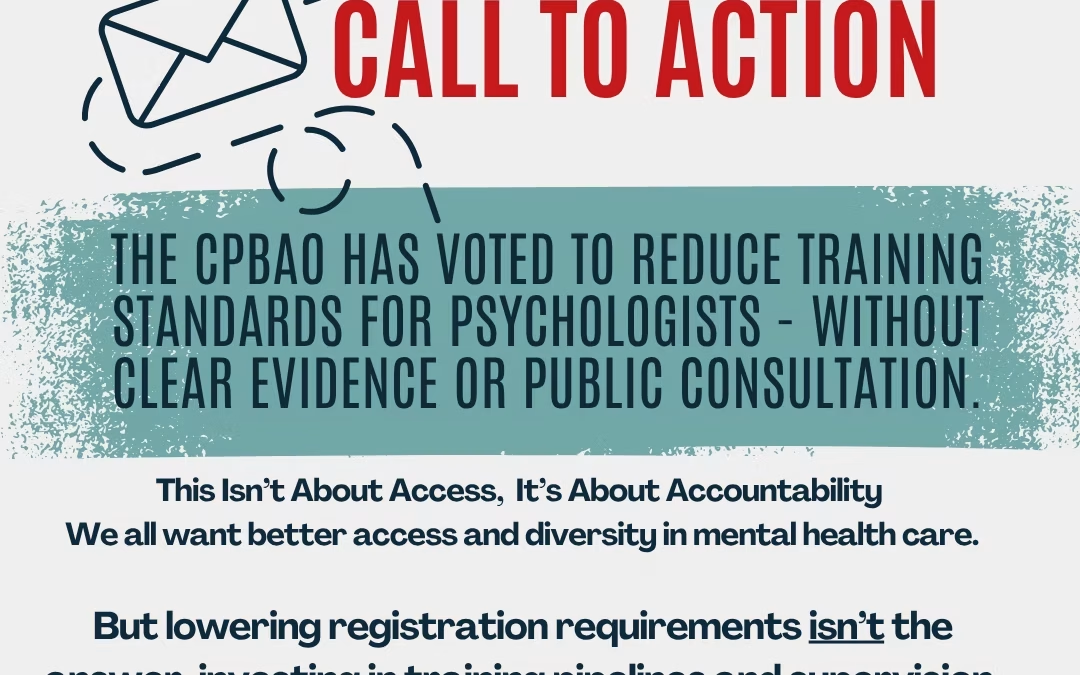
by jennbossio | Nov 7, 2025 | Advocacy
Something incredible is happening in Ontario right now.
Across the province, psychologists, psychological associates, and graduate students have come together to form the Psychology Advocacy Network (PAN) — an independent, grassroots group deeply concerned about what’s unfolding within our regulatory body and the potential impact on mental health care for every person in Ontario.
This group isn’t backed by a single organization or institution. It’s made up of clinicians and students who love what they do, who have trained for years to do it well, and who are united by one simple goal: to protect the integrity of mental health care in Ontario.
What’s Going On?
As I’ve written about quite a bit over the past few months, the College of Psychologists and Behaviour Analysts of Ontario (CPBAO) has recently proposed sweeping changes to the education and training requirements to become a psychologist in this province. These changes — described as “modernization” (ha!) — would reduce psychology training standards by approximately 75%.
In practical terms, this could mean:
- Wayyy fewer supervised clinical hours before independent practice
- Elimination of the oral exam (as in, the guardrails to ensure clinicians know how to practice ethically and safely)
- A single, minimal practicum rather than the extensive placements psychologists currently complete (a reduction of 75-90% of training, which is wild)
- Removal of the 4-year supervised work requirement for master’s-level candidates (dropping Ontario down to the lowest standard in the country)
Historically, Ontario psychologists have completed about six years of supervised training before being licensed to work independently. Under the proposed model, someone could be licensed in as little as two years.
That might sound like an administrative efficiency, but in reality, it represents a fundamental shift in how psychologists are trained to work with people who are struggling with trauma, neurodevelopmental disorders, complex mental illness, or life-altering diagnoses.
Why It Matters
Every day, psychologists in Ontario provide services that go far beyond talk therapy.
They conduct assessments that determine whether a child has a learning disability and needs school support.
They diagnose conditions like ADHD, autism, depression, anxiety, and PTSD.
They help people navigate the psychological impact of chronic illness, fertility challenges, disability, or trauma.
When that kind of work is done poorly, the consequences ripple outward, affecting education plans, medication decisions, access to funding, workplace accommodations, and quality of life.
Lowering training standards will not improve access to care. It simply risks lowering the quality of care while leaving the real issues — funding, accessibility, and systemic barriers — untouched.
As many have said, this isn’t about more psychologists.
It’s about maintaining the expertise that people count on when they finally reach out for help.
Why the Psychology Advocacy Network Gives Me Hope
In the face of these changes, psychologists, psych associates, and students from across Ontario have stepped up to build the Psychology Advocacy Network (PAN) from the ground up.
They’ve created an incredible website that clearly outlines the issues, provides transparent information, and — most importantly — gives every Ontarian a voice in this conversation.
If you are a member of the media, they also have developed a centralized hub to direct all media inquiries (click here).
You can visit it here:
👉 protectpsychology.ca
The website includes background information, references, and a direct link where anyone — not just psychologists — can send a message opposing the proposed changes.
Because this isn’t just a professional issue.
It’s a public one.
What You Can Do
If you care about mental health care in Ontario — as a client, parent, teacher, health professional, or simply as a person who values quality and safety — please take a few minutes to:
- Visit protectpsychology.ca
- Read about what’s happening and why it matters.
- Click the link to “Vote No” to these changes.
It only takes a minute, but it sends a powerful message: that Ontarians care about high-quality, evidence-based, and ethical mental health care.
A Personal Note
As a psychologist, I’ve never been prouder to be part of this profession, or to stand alongside such a passionate, intelligent, and diverse group of colleagues who care deeply about doing what’s right for the people we serve.
The Psychology Advocacy Network is proof that when we come together — clinicians, students, and members of the public — we can speak with one clear voice: Mental health care in Ontario matters. Let’s protect it.
Take Action → protectpsychology.ca

by jennbossio | Sep 28, 2025 | Advocacy
A Crisis Decades in the Making
Ontario’s mental health system is in crisis. Families wait months or even years for psychological assessments. Adults with trauma, depression, or anxiety often find themselves navigating a confusing, underfunded system where timely care is scarce unless they can afford private services. Individuals with severe addiction or psychiatric disorders find themselves unhoused and hopeless.
This is not a new problem. In the 1990s, the Ontario government quietly cut many psychologist positions from hospitals. The result was a slow but steady dismantling of publicly accessible mental health care. Psychologists, once embedded in hospitals and community health teams, became increasingly concentrated in private practice. Families without insurance or disposable income were left behind.
Decades later, the consequences are undeniable. Ontario now has one of the most privatized mental health systems in Canada. Wealthier Ontarians access highly trained psychologists in private clinics. Those without resources face long waits, inconsistent services, or no care at all.
The COVID-19 pandemic pushed this fragile system over the edge. Demand for mental health services spiked, conditions became more complex, and existing cracks in the system deepened. By 2020, the Ontario government itself admitted there was a crisis.
“The Roadmap to Wellness“
In March 2020, the government announced the Roadmap to Wellness, its ten-year plan to transform Ontario’s mental health and addictions system. The plan promised to:
- Improve quality by building a consistent, evidence-based system.
- Expand access by increasing the number of services available.
- Reduce wait times through better coordination.
- Strengthen community services to ensure people could access support outside of hospitals (Government of Ontario, 2020).
These pillars reflected what psychologists had been saying for years: access was fragmented, quality varied, and too many people were falling through the cracks. The dissolution of psychiatric hospitals decades earlier had left Ontario with a disjointed, underfunded patchwork of services.
Yet, while the Roadmap acknowledged the crisis, it came without the necessary funding commitments. Instead of reinvesting in psychologists and other highly trained providers, the province began to look for faster and cheaper ways to appear as if they were “solving” the problem, with little attention to ensuring longevity of those solutions.
The Fairness Commissioner and the Push for “Access”
Enter the Office of the Fairness Commissioner (OFC). Since 2020, the OFC has been monitoring Ontario’s regulated professions, including psychology, to ensure registration practices are transparent and fair.
Year after year, the OFC flagged concerns with the College of Psychologists of Ontario (CPO, now CPBAO):
- Too many appeals from applicants denied registration.
- Long supervised practice requirements, particularly for internationally trained professionals.
- Equity concerns, including the underrepresentation of racialized members in doctoral-level pathways (Office of the Fairness Commissioner, 2023; 2024).
The OFC’s mandate is important. Internationally trained professionals deserve fair access, and barriers that are unnecessary should be addressed. But instead of carefully reforming registration while preserving public safety, the government saw an opportunity.
In 2023, Ontario passed “as of right” legislation, giving itself authority to override professional colleges in the name of labour mobility. This meant the Ministry of Health could dictate registration standards directly. For psychology, this opened the door to radical deregulation; not to better serve the public, but to reshape the profession in ways that fit the government’s cost-cutting agenda.
Slashing Standards
By 2025, the CPBAO—under pressure from the Ministry—introduced sweeping changes. Historically, Ontario psychologists trained for at least six years under close supervision:
- Master’s and PhD degrees.
- Multiple supervised practica.
- A full-year clinical residency.
- A year of supervised practice post-degree.
- Three licensing exams (including oral and ethics).
Master’s-level psychologists, too, were required to complete four years of supervised work experience after graduation, in addition to exams.
These safeguards existed for a reason: psychologists hold the controlled act of communicating diagnoses, meaning they determine whether someone has ADHD, autism, PTSD, or another condition that can change the trajectory of a person’s education, medical care, and life.
The new rules would slash these standards by a minimum of 60%:
- Only one practicum is now required.
- The oral examination is eliminated.
- The ethics exam has been replaced with a no-fail online module.
- The four-year supervision requirement for Master’s graduates is gone.
In effect, a new registrant could become a psychologist with as little as two years of practical training, compared to seven or more under the old system.
The Truth Behind the Reforms
At first glance, this may look like efficiency. Ontario needs more psychologists, so why not make the process to become a psychologist faster…like, way faster? But this is where the story takes a darker turn.
The real bottleneck in Ontario is not the number of therapists. Social workers and psychotherapists already provide high-quality therapy across the province. The creation of the College of Registered Psychotherapists (CRPO) in 2015 has seen an astronomical rise in access to mental health care supports for individuals with the means to afford them. The problem is that their services are rarely covered by OHIP. For a country that prides itself on free access to health care, and a province who has planted their flag in the name of improving mental health supports, they have completely failed to address the fact that we are facing a funding crisis, not a workforce shortage.
Where Ontario is short is in diagnostic capacity. Only psychologists can perform the assessments that lead to formal diagnoses of ADHD, autism, learning disorders, PTSD, depression, anxiety, and complex mental illnesses. Weakening training in this area simply does not create more capacity; instead, it creates more risk of misdiagnosis.
So why is the government pushing this? The answer is austerity.
By lowering training standards, Ontario can create a new class of psychologists who cost far less to employ. These minimally trained professionals can then be hired to staff underfunded public positions, tasked with treating the sickest and most complex patients; the very population the Roadmap to Wellness identified as needing the highest-quality care.
Meanwhile, highly trained psychologists—those who have the resources to continue onto a PhD, or who earned a PhD level training from outside of Ontario—will continue to leave the public system for private practice, where salaries reflect the years of training required. The government gets to say it has “solved” access, but in reality, it has the very serious potential to create a two-tiered system:
- Low-paid, minimally trained psychologists in the public system.
- Highly trained psychologists in private practice, available only to those who can afford them.
At the September 26th CPBAO council meeting (which you can watch in full on YouTube at the time of writing this article), the writing was on the wall. Government representatives came in with sweeping changes already in hand and little interest in hearing the serious concerns raised by council members. The government officiale laid bare the logic behind this approach:
“We may not agree that the same quality of care is there. And I’m not sure about that. But I know that no care is not good quality of care.”
This statement is revealing. It suggests that the government knows quality will suffer, but is prepared to accept that trade-off for the sake of optics. Framed as a choice between “worse care” and “no care,” the conclusion was that Ontarians should take what they can get.
Once you stand back, the pattern is clear. This isn’t about improving access responsibly. It’s about political cover. The government can claim it has fixed the crisis while quietly cutting costs and shifting the risks onto the public. Ontarians are being asked to accept diminished care so that politicians can congratulate themselves for doing “something.”
Equity Undermined, Not Advanced
The Office of the Fairness Commissioner has raised concerns for years about the lack of diversity within psychology, particularly the underrepresentation of racialized members in the doctoral pathway (Office of the Fairness Commissioner, 2023; 2024). On the surface, lowering standards has been pitched as a way to help fix this, but reducing barriers for BIPOC folx to registration.
But the reality is far more insidious. The two-pathway system that I foresee coming based on these changes risks making inequities worse. Those with family wealth and the ability to delay earning an income will continue to pursue PhDs. They will end up in higher-paying roles, both in private practice and in leadership. Meanwhile, students who cannot afford to wait—disproportionately first-generation, racialized, and lower-income trainees—will be forced to stop at the Master’s level simply to get to work.
The result is predictable:
- Affluent students pursue doctorates, earn higher incomes, and consolidate privilege.
- Lower-income students stop at Master’s, enter the workforce sooner, and become the pool of lower-paid psychologists staffing underfunded public roles.
This is exploitation. The government positions itself as opening doors, but in practice it’s proposed changes create a two-tiered professional class it can prey on; one highly paid and protected, the other underpaid and overburdened.
In the name of diversity, Ontario risks building a system that entrenches inequality.
Why This Matters for Ontarians
For the public, the implications are stark:
- More confusion. The title “psychologist” will no longer guarantee the level of training it once did.
- Greater risk of harm. Misdiagnoses could rise, particularly for marginalized communities already at risk of being misunderstood or pathologized.
- No real increase in access. Services for the vast majority of Ontarians who are in need to mental health services will still not be OHIP-covered, leaving most still paying out-of-pocket.
- Taxpayer dollars wasted. Short-term savings from lower salaries int he public sector could balloon into long-term costs from untreated or mismanaged conditions.
The “Elitism” Distraction
At a recent meeting with the CPBAO, the Fairness Commissioner himself reportedly shouted, “You’re elitists!!!” at psychologists raising concerns about lowered standards. The charge is both inaccurate and dangerous, because it dilutes the real risks facing Ontario’s mental health system.
This is not about elitism. Psychologists with PhDs are not holding their degrees over the head of their MA-trained peers. Further, psychologists are not claiming to be “better than” other mental health providers. Different professions exist precisely because different scopes of practice require different training.
No one accuses dentists of elitism because they complete more training than hygienists. No one demands that physicians shorten medical school to solve a doctor shortage. Yet, for reasons that are hard to ignore, psychology is being singled out.
Labeling psychologists as elitist obscures the truth: lowering standards by upwards of 60% is not about equity or access, it’s about creating a cheaper workforce. It’s a rhetorical sleight of hand. By painting professionals as gatekeepers protecting their privilege, the government distracts from its own responsibility to fund a system that provides safe, effective mental health care to a public in need.
The risk is not that psychologists are clinging to status. The risk is that Ontarians will be left with underprepared clinicians handling the most complex and vulnerable cases in the province. This is a matter of public safety.
Calling psychologists elitist is a way to shut down debate. But it’s Ontarians—not psychologists—who will pay the price if care gets watered down.
The Roadmap Betrayed
The Roadmap to Wellness promised to improve quality, expand access, reduce wait times, and strengthen community services. All of these are critically important. But lowering training standards for psychologists by such a drastic degree undermines all four pillars.
- Quality suffers when training is gutted.
- Access remains limited without OHIP coverage.
- Wait times for assessments will not shrink if new psychologists lack the skills to provide them.
- Community services are not strengthened by inserting underprepared providers into the most complex roles.
In short, the government is betraying its own plan.
A Better Path Forward
If Ontario truly wants to fulfill the Roadmap, the solution is not cutting corners but investing in the system. That means:
- Fund psychologists in hospitals and schools. Restore the positions cut in the 1990s.
- Cover mental health services under OHIP. Make therapy and assessment affordable for everyone.
- Support diversity responsibly. Provide scholarships, mentorship, and pathways for internationally trained professionals, rather than lowering standards.
- Expand training capacity. Create more residency and supervision placements, rather than shrinking them.
This is how we can increase access without sacrificing quality.
What Ontarians Can Do
My hope (although admittedly I am not sure at this point) is that this is not inevitable. We have entered into a 60 day period for public feedback. Here’s how psychologists, allied providers, and most importantly, the public can act:
- Contact your MPP. Demand funding for mental health care, not weakened standards.
- Write to the Fairness Commissioner. Share concerns about the risks to public safety.
- Support advocacy groups. The Ontario Psychological Association and allied groups are mobilizing.
- Tell your story. Share your experience with waitlists, assessments, or gaps in care. Policymakers listen when the human impact is clear.
Ontarians Deserve Better
The Ontario government says it is expanding access for mental health supports, but in reality, it is lowering standards and calling it progress. The Roadmap to Wellness set out the right goals, but those goals cannot be met by gutting the very profession designed to deliver them.
Ontarians don’t need worse care. They need real care. And they need a government willing to pay for it.
References
College of Psychologists and Behaviour Analysts of Ontario. (2025). Changes to registration and training standards. Toronto, ON.
Government of Ontario. (2020). Roadmap to wellness: A plan to build Ontario’s mental health and addictions system. Retrieved from https://www.ontario.ca/page/roadmap-wellness-plan-build-ontarios-mental-health-and-addictions-system
Office of the Fairness Commissioner. (2023). Annual report 2022–2023: A tipping point for fair registration practices. Toronto, ON.
Office of the Fairness Commissioner. (2024). Annual report 2023–2024: A breakthrough year for fair registration practices. Toronto, ON.
Dr. Jenn Bossio is a Clinical and Health Psychologist, the founder and director of the Tri Health Clinic—Ontario’s largest sex and couples therapy practice—and a passionate advocate for system-level change in mental health care. Based in Kingston, she was named Business Person of the Year (2025) and recognized as one of the Top 40 Under 40 (2024). Jenn is committed to redefining the role of psychologists in a rapidly evolving health care landscape.

by jennbossio | Sep 28, 2025 | Advocacy
The Mixed Response to the Petition
When graduate student, Meghan Ford, and I released a petition responding to the College’s proposed changes to registration standards, the response was immediate. Many colleagues signed enthusiastically. Others reached out with thoughtful critique, raising concerns about specific wording or the balance between master’s and doctoral training. And then, unfortunately, there were also deeply negative reactions, including personal attacks directed toward the graduate student who helped with the effort. That kind of vitriol is unfair, and it distracts from the real issue at hand: the future of psychology in Ontario.
Why We Acted Quickly
The petition was written quickly, before we had the benefit of the full information that has since come to light. We knew this meant the language might not capture every nuance. But we also knew that delay risked being interpreted as consent. In advocacy, sometimes you have to move fast with the tools you have. This is also a generally unpopular stance for a profession like psychology, full of deeply caring people who thrive in diving into the nuance.
It’s also important to acknowledge our own positionality. I hold a PhD and Meghan is in the process of completing hers. It’s possible that our language was shaped by that perspective in ways we couldn’t fully see. Personally, I don’t read it as anti–master’s level, but I understand that others may have interpreted it differently, and I want to own the possibility of bias.
What the Petition Isn’t Saying
The petition is not about opposing master’s-level psychologists. In fact, many of us work alongside excellent master’s-trained colleagues every day, and they are indispensable members of our profession. In fact, in my own mid-sized private practice, I have had the privilege and pleasure of hiring and working along-side MA-level psychologists. The issue is not whether MA-level psychologists should exist (I find that argument laughable, even); they already do, and they are deeply valued.
The real issue is the scope of the changes now being pushed forward in response to the lack of access to psychologists. Under current standards, psychologists in Ontario typically complete between 3,000 and 6,000 hours of supervised clinical training before practicing independently. The proposed changes would reduce this to as little as 300–500 hours. That’s a reduction by a factor of 10… a factor of 20, even! This is not a minor adjustment. It is a dismantling of the standards that have protected the public and defined our profession.
“Any Care is Better Than No Care”?
One of the most troubling messages coming from government is the idea that “worse care is better than no care.” This is a dangerous oversimplification. Ontario already has thousands of professionals who provide therapy; social workers, psychotherapists, counsellors. What psychologists uniquely provide is the controlled act of diagnosis and complex psychological assessments. These are the bottlenecks in the system: assessments for ADHD, autism, neuropsychological conditions, PTSD, learning disorders.
Shortening training won’t fix those waitlists. It risks producing clinicians who are less prepared for exactly the areas where Ontarians are most in need.
The Funding Elephant in the Room
The real reason psychologists are not more available in hospitals and community agencies is not training standards, it’s funding.
A psychologist working in a hospital is paid roughly one-sixth of what they could earn in private practice for the exact same training and the exact same scope of practice. To put that in real terms: it’s like telling a doctor, “If you choose to work in a hospital and serve the sickest patients, we’ll pay you a dime for every loonie your colleagues earn down the street.” Who would stay?
This is the reality facing psychologists. It should surprise no one that many move to private practice. But instead of addressing this pay gap, the government is proposing to slash training requirements by 80–90% and call that “increasing access.” It’s not. It’s a bait-and-switch that lowers quality without solving the actual problem.
Lowering standards won’t solve this imbalance. Only government investment in fair compensation and funded training spots will.
Why the Petition Still Matters
Some colleagues have suggested that the petition isn’t nuanced enough, and they’re right. It isn’t. But the petition was never meant to be a comprehensive policy document. It’s not even a formal submission; the government only accepts paper petitions.
What the petition is meant to do is show the public, policymakers, and the media that psychologists are dissatisfied with the direction being taken. It is a signal of concern, not the final word.
This is where unity matters. If we fracture over small details, if we withhold support because the language isn’t perfect, we weaken our collective voice. The public cannot parse the difference between psychologists, psychological associates, and other regulated mental health professionals. They only see whether we stand together or not.
The Path Forward
Nuance will be essential as we move into the formal consultation process. We will need thoughtful position papers, carefully worded submissions, and respectful debate about the future of our profession. But we can’t let perfectionism stop us from acting in the meantime.
The bottom line is this: Ontario does need more psychologists. But the solution is not to gut training standards by 80–90%. The solution is to fund more training spots, invest in public-sector salaries, create more clinically-focused programs (like PsyD’s), and support specializations like neuropsychology where bottlenecks are most severe. Anything less is is abandonment of the public interest in the name of “modernization.
Dr. Jenn Bossio is a Clinical and Health Psychologist, the founder and director of the Tri Health Clinic—Ontario’s largest sex and couples therapy practice—and a passionate advocate for system-level change in mental health care. Based in Kingston, she was named Business Person of the Year (2025) and recognized as one of the Top 40 Under 40 (2024). Jenn is committed to redefining the role of psychologists in a rapidly evolving health care landscape.